Welcome OR Wisdom?
The Preposition That Changes ... maybe complicates but certainly redeems ... Everything


There is a moment in Revelation 5:9 that most readers pass over without noticing.
The new song declares that the Lamb was slain and by his blood purchased for God persons ek pases phules kai glosses kai laou kai ethnous: out of every tribe and tongue and people and nation.
The preposition is ek, not apo. This matters.
Apo marks simple separation or origin, a neutral departure from a source. Ek carries something stronger: extraction from within, emergence out of a prior context.
When the text says people are gathered ek every nation, it is not simply saying they originated there. It is implying they have been drawn out from those contexts, that belonging to the community of the Lamb involves a genuine departure from prior allegiances and ideologies … whilst retaining their identity and allegiance to their people group. That’s where it starts to get really … complicated.
This is the theological spine underneath a reel I filmed this week at Penarth esplanade, beside the Italian Garden. Wales as a Nation of Sanctuary is the pastoral and civic question on the surface.
The deeper question is what welcome actually requires, both of the one who offers it and of the one who receives it.

The fourfold formula, phule / glossa / laos / ethnos, draws on Daniel 3 and 7, where it describes the totalising reach of imperial power (Nebuchadnezzar commands every nation and language, Daniel 3:4).
John repurposes the formula: the community of the Lamb is gathered from the full scope of humanity, but gathered out from it. The empire gathers by force and flattening. But the Lamb gathers by redemption and transformation.
That transformation is the point.
Welcome into this community is genuinely universal in scope. But the ek signals that it is not ideologically neutral. Something is left behind. Prior allegiances that do not coexist with the Lamb’s community are not accommodated; they are surrendered.
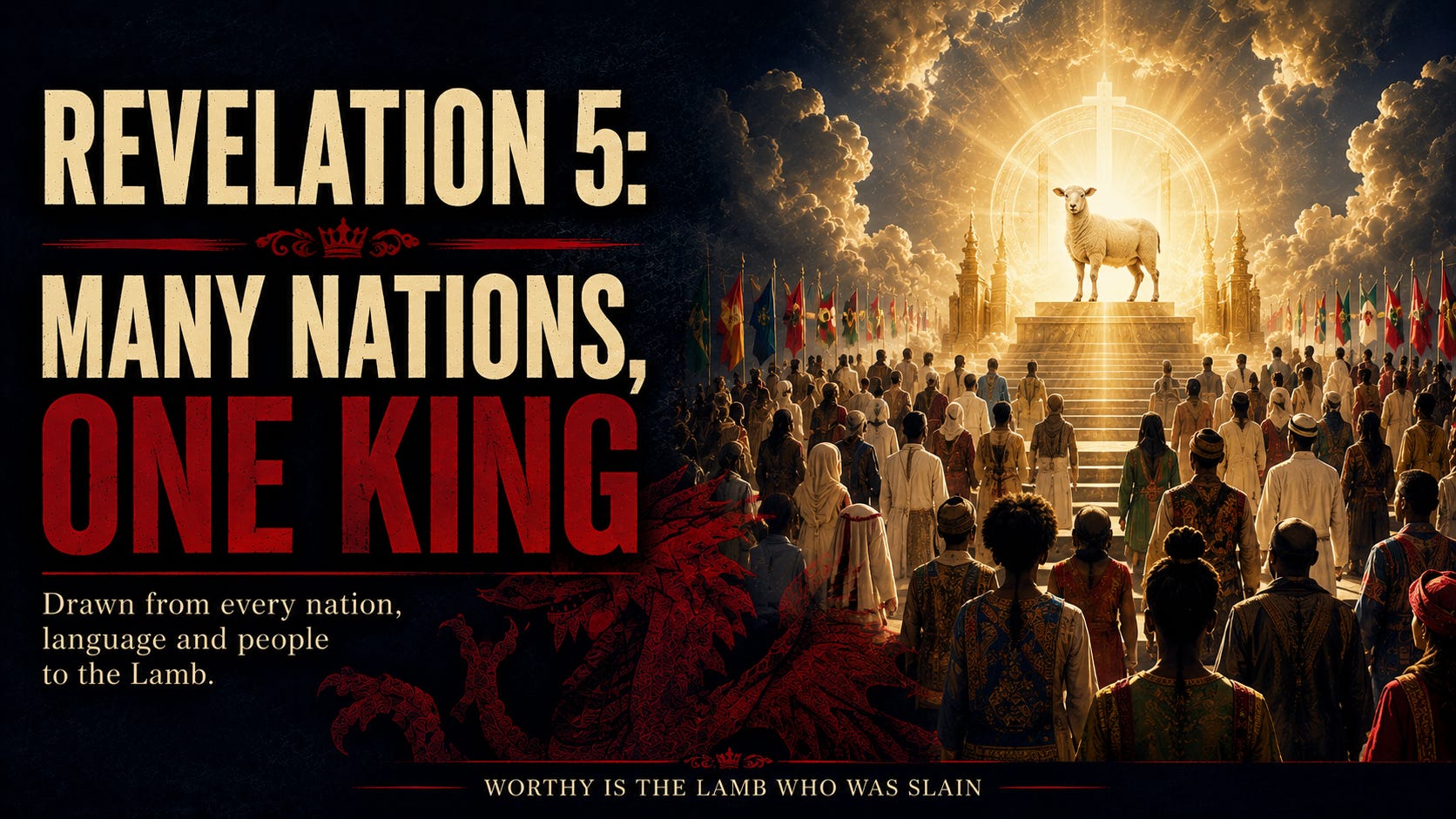
Applied to the civic question of sanctuary: a Nation of Sanctuary that has thought clearly about its own identity and values is not a restricted welcome. It is actually a more honest one. It knows what it is offering and what, reasonably, it invites the newcomer into.
That is not hostility. That is the logic of ek.

Free copy of Mark’s Gospel here: https://live.bible.is/bible/ENGNLH/MRK/1
Quiz
Q1: What is the Greek preposition used in Revelation 5:9 to describe where the redeemed are gathered from?
A: ek
. . .
Q2: What is the key difference between ek and apo in Greek usage?
A: Apo marks simple origin or separation; ek implies extraction from within a prior context, carrying a stronger sense of departure and distinction.
. . .
Q3: What is the fourfold formula in Revelation 5:9, and where does it originate in the Old Testament?
A: Phule (tribe), glossa (tongue/language), laos (people), ethnos (nation). It originates in the Aramaic formula in Daniel 3 and 7, where it describes the totality of peoples under imperial command.
. . .
Q4: How does John’s use of the formula in Revelation differ from its use in Daniel?
A: In Daniel it describes the reach of human imperial power, gathering all peoples under a king’s authority by force. In Revelation John repurposes it to describe the community of the Lamb, gathered not by coercion but by redemption, and gathered out from those empires rather than into one.
. . .
Q5: What civic and missiological implication does the reel draw from the ek formula?
A: That genuine welcome, whether the welcome of the Lamb or the welcome of a Nation of Sanctuary, is not ideologically formless. The ek implies that something is left behind. A host community that is clear about its own identity and values is offering a more honest welcome, not a more restricted one.